



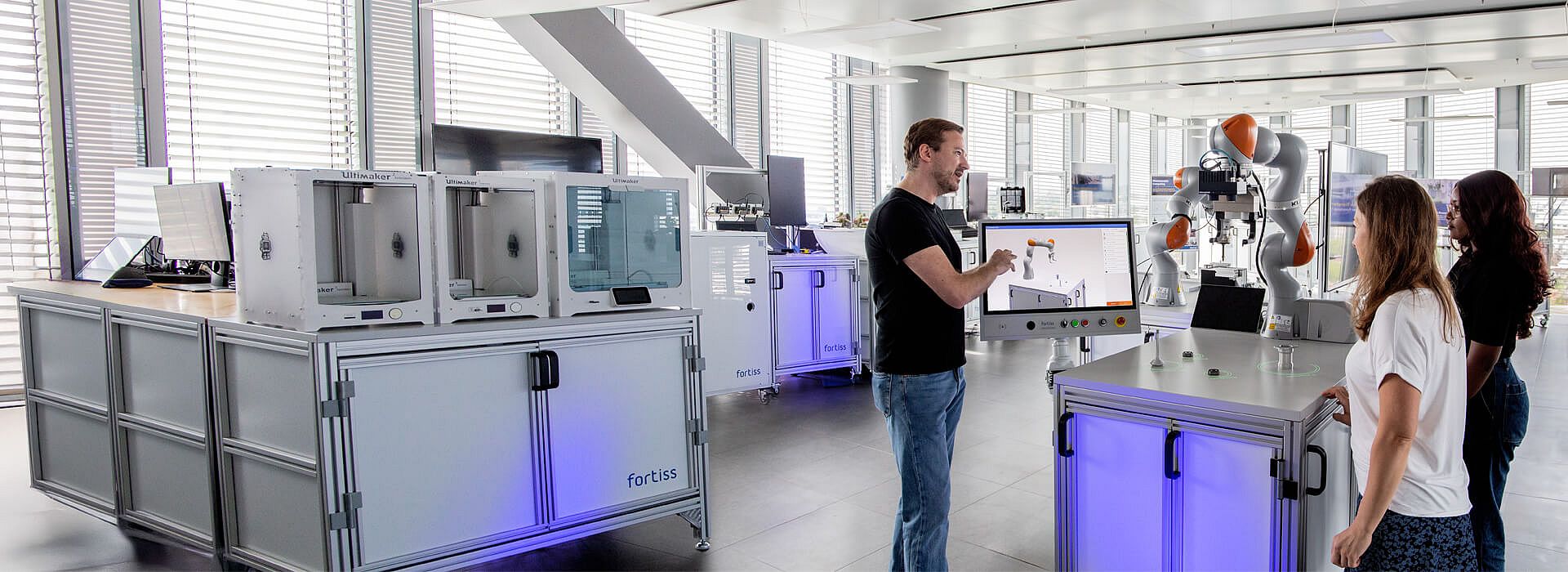
Flexible and intelligent production for small batches
Robotics Lab
The demonstrators developed within the framework of the Robotics Lab represent an open platform for discussions and for jointly shaping the production systems of the future. The demonstrators also serve to evaluate and validate research results and disseminate them to a wide audience ranging from industry partners and academic institutes, to interested students. The activities focus on a knowledge-based systems engineering approach for robotics-supported cyber-physical production systems (CPPS), particularly research into ontology-based concepts for the semantic interoperability of production resources and knowledge-based autonomous production.
Using real application scenarios, the lab illustrates how the developed methods can satisfy the requirements of small-to-medium enterprise manufacturers (SMEs). This includes the required efficiency improvements during the design, configuration and operational phases in order to cost-effectively implement customer-specific small-batch production as well.
Focus
The Robotics Lab demonstrates how synergy effects can be generated and exploited by means of semantic integration and the interpretation of heterogeneous information and data sources. This leads to a deeper understanding of the production goal and its implications, which represent the foundation for autonomous production.

SMEcobot
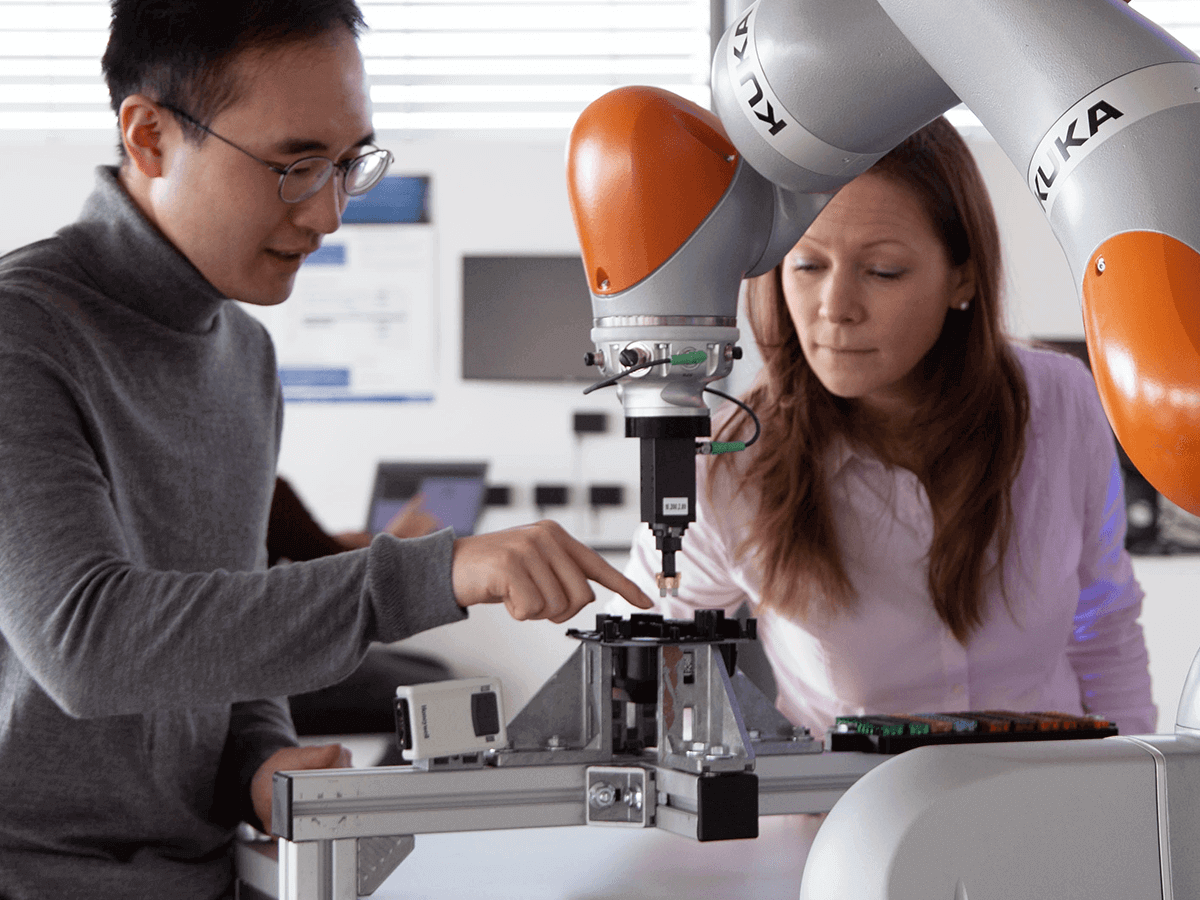
The SMEcobot demonstrator showcases a knowledge- and model-based approach to robot-assisted automation of the future. Semantic models of products, processes, and production resources are used for this purpose. The aim is to systematically link relevant knowledge to the respective automation task in order to effectively and efficiently support product development as well as the instruction and operation of automation systems.
The demonstrator includes the following functions, among others:
An assembly task is specified via a graphical user interface using a no-code approach. This specification can be mapped by the robot system to its own capabilities and then executed autonomously.
Natural language queries from operators about the geometric properties of products are translated into formal queries to CAD models using large language models (LLMs) and answered automatically.
Services
- Research
Core research topics are knowledge-based approaches to digitalization in manufacturing companies. For this purpose, formalized production-relevant knowledge is used to enable a more intuitive instruction and operation of cyber-physical systems and to increase their degree of autonomy. Collaborations with external partners can be established based on various cooperation and funding models. - Information
There are opportunities for informal exchange with representatives from science and industry, and in particular Bavarian SMEs. The focus is on current state-of-the-art approaches for digital engineering and autonomy in production. - Prototypes
Prototype demonstrators illustrate current research results:- Flexible Plug&Produce systems based on standardized OPC UA skills for machines, robots, and tools.
- Intuitive and efficient instruction of robot systems
- Autonomous production for customized products with small batch sizes
- Customized solutions
Adaptations for user-specific problems are developed together with application partners. Of great interest here is how scientific insights can be transferred to new use cases. - Network
fortiss cooperation partners gain access to a comprehensive and high-caliber ecosystem consisting of representatives from science, industry, and interface institutions. This provides the opportunity to network and exchange experiences and insights. - Qualification
In the context of lab courses and seminars at the Technical University of Munich, the Robotics Lab conveys a broad spectrum of application-oriented expertise to interested students.
Fields of competence

Digital sovereignty through robust and trustworthy platforms

Energy-efficient AI for mobile and industrial applications
Projects
Intelligent human-robot collaboration for flexible and cognitive production systems
Intuitive programming for interoperable robot systems
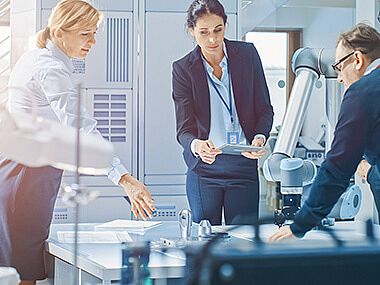
Collaborative robotics for flexible and human-centered production
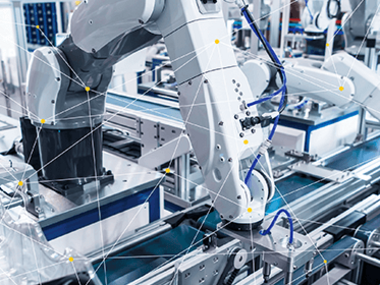
Data infrastructure for continuous production without system interruptions
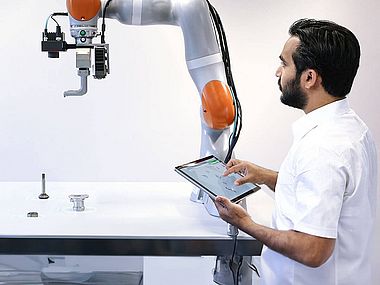
Programming and operating robots without expert knowledge