



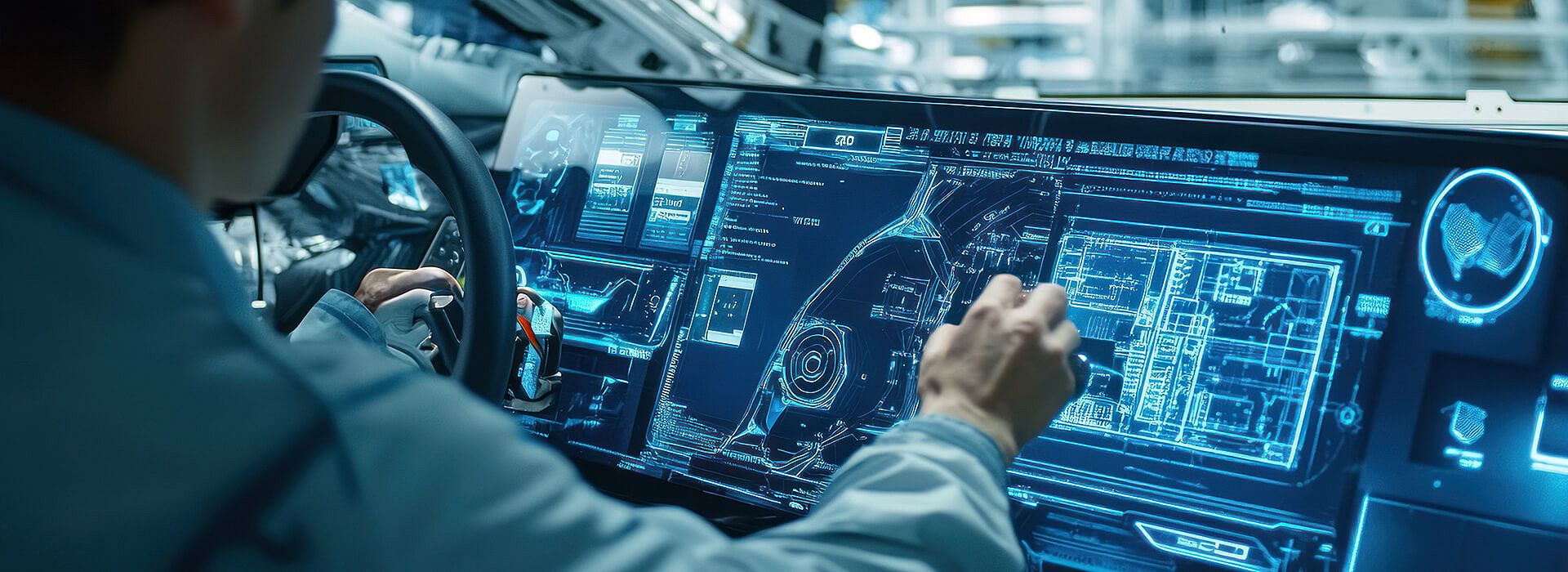
Automation of vehicle electrical systems through AI and multi-agent systems
Agent-X
Project description
A key challenge in automotive production is wiring harness manufacturing. Despite technological advances, it remains a highly manual process, with around 85% of the main wiring harness being produced by hand. Automated processes have so far failed due to the lack of order and structure in the wiring systems.
Wiring harnesses consist of numerous cables that are connected via pin assignments with plugs, but without any overarching organizational principle. This complex interconnection complicates production and prevents high machine throughput.
The Agent-X project is therefore developing methods for the virtual mapping of wiring harness architectures. The aim is to holistically optimize the entire electrical and electronic system – including control units, connector interfaces, power distributors, and wiring harnesses.
Only a holistic approach can enable an efficient structure that increases the productivity of wiring harness production. The expected results include a shortening of the development process, the economic automatability of wiring harness production, cost reductions for power distributors and control units through optimal resource allocation, and a scalable electrical/electronic architecture for customizable vehicles.
Research contribution
As part of this project, fortiss is contributing its extensive expertise in mathematical modeling, AI-based optimization methods, multi-agent systems, graph neural networks (GNNs), and large language models (LLMs).
Particular attention is paid to reinforcement learning in order to take into account the numerous and sometimes competing requirements in vehicle electrical system development. Graph neural network approaches are used to evaluate and ensure the quality of the network structures generated. In addition, large language models are used to automatically convert textual requirements into mathematical constraints.
Project duration
01.01.2026 - 31.12.2028
Contact

Project partner