



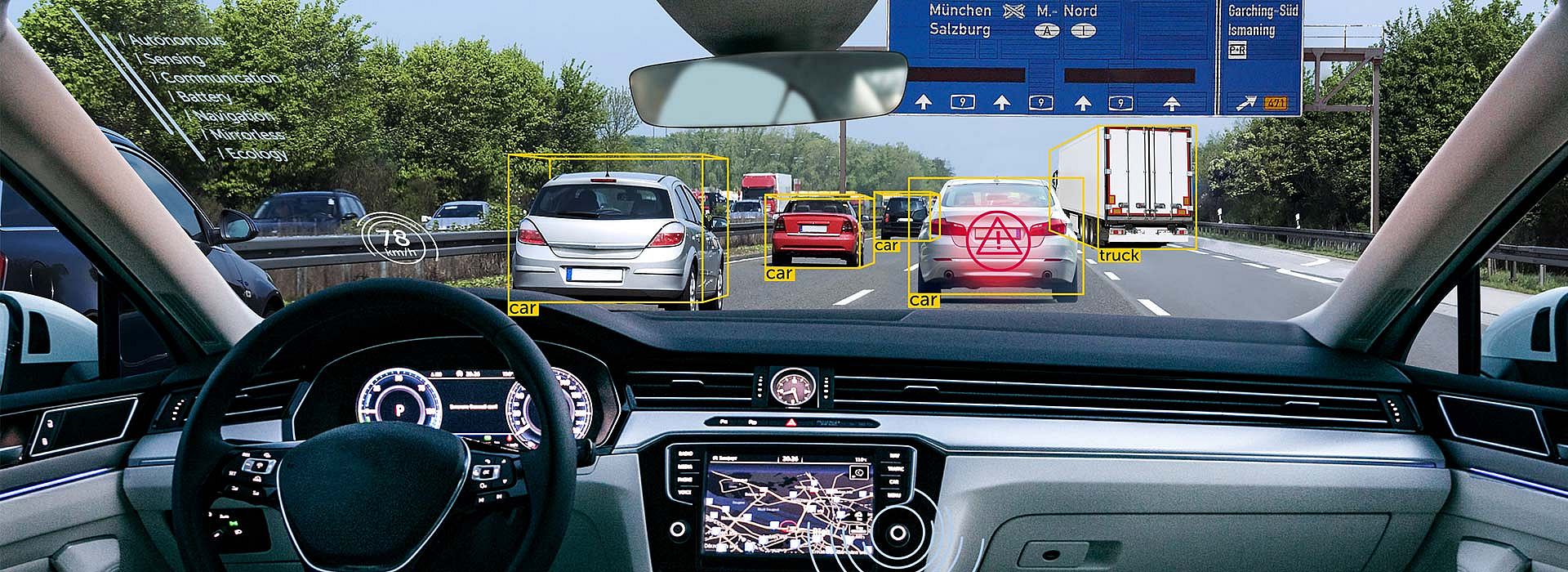
Sicheres, vernetztes Fahren auf der digital unterstützten Autobahn
Providentia
Projektbeschreibung
Im Rahmen der „Förderrichtlinie automatisiertes und vernetztes Fahren auf digitalen Testfeldern in Deutschland“ des Bundesministeriums für Verkehr und digitale Infrastruktur (BMVI) wird im Projekt „Providentia“ – Proaktive videobasierte Nutzung von Telekommunikationstechnologien in innovativen Autobahn-Szenarien" – dem Fahrer, und im Fall von hochautomatisierten Fahrzeugen dem Fahrzeug selbst, ein möglichst umfassender Vorausblick auf die Strecke ermöglicht.
Dies soll zuverlässig, situationsangepasst und auch unter widrigen Umweltverhältnissen funktionieren, wobei Informationsüberfrachtung vermieden wird. Grundlage für den Vorausblick ist der Einsatz von Mobilfunksystemen der modernsten Generation und leistungsstarker verteilter Sensorik.
Forschungsbeitrag
Erwartet werden wegweisende Erkenntnisse sowohl für die Technik des Mobilfunks der nächsten Generation (5G) als auch für die Erzeugung hochzuverlässiger Abbilder der Realität in der Infrastruktur (Backend) durch Sensorfusion, für die Informationsversorgung vernetzter hochautomatisierter Fahrzeuge, für die Virtualisierung komplexer Verkehrsszenarien und wesentlich auch für die anstehenden Normungen des Mobilfunks der fünften Generation.
Förderung
Projektdauer
1.12.2016 - 31.12.2021

Wenn Sie dieses Video aktivieren, werden Daten automatisiert an YouTube übertragen.
Wenn Sie dieses Video aktivieren, werden Daten automatisiert an YouTube übertragen.
Kontakt

Weitere Informationen
Projektpartner







Publikationen
- What the Constant Velocity Model Can Teach Us About Pedestrian Motion Prediction In Robotics and Automation Letters (RA-L), Paris, France, 2020. IEEE. Details URL BIB
- Targetless Rotational Auto-Calibration of Radar and Camera for Intelligent Transportation Systems In Intelligent Transportation Systems Conference (ITSC), Auckland, New Zealand, 2019. IEEE. Details BIB
- Providentia - A Large Scale Sensing System for the Assistance of Autonomous Vehicles In Robotics Science and Systems Workshops (RSS Workshops), Freiburg, Germany, 2019. RSS Foundation. Details URL BIB
- InCarAR: A Design Space Towards 3D Augmented Reality Applications in Vehicles In Proceedings of the 11th International Conference on Automotive User Interfaces and Interactive Vehicular Applications, 2019. ACM. Details DOI BIB
- I Drive - You Trust: Explaining Driving Behavior Of Autonomous Cars In Extended Abstracts of the 2019 CHI Conference on Human Factors in Computing Systems, pages LBW0163:1–LBW0163:6, 2019. ACM. Details URL DOI BIB
- Benefits and Challenges of Smart Highways for the User In IUI Workshops, 2019. Details BIB
- Deep Reinforcement Learning for Predictive Longitudinal Control of Automated Vehicles In Proceedings of the 21st International Conference on Intelligent Transportation Systems (ITSC), pages 2391-2397, 2018. IEEE. Details URL DOI BIB
- Early Take-Over Preparation in Stereoscopic 3D In Adjunct Proceedings of the 10th International Conference on Automotive User Interfaces and Interactive Vehicular Applications, pages 142–146, 2018. ACM. Details URL DOI BIB
- Highway Sensor System as Enabler for Autonomous Driving In volume CHI 2018 Workshop - Interacting with Autonomous Vehicles: Learning from other Domains(2018), 2018. Details BIB
- Designing a far-reaching view for highway traffic scenarios with 5G-based intelligent infrastructure In 8. Tagung Fahrerassistenzsysteme, Munich, Germany, 2017. TÜV Süd. Details URL BIB