



Digital resiliency for reliable security systems
Conflicts are no longer confined to the traditional battlefield – they are increasingly taking place in the digital sphere. Cyber defense is now a central component of modern strategies and requires innovative approaches. Digitalization, networked systems, and increasing demands for autonomy, cyber resilience, and reliable software architectures are opening up completely new possibilities for defense technologies.
fortiss addresses these security- and technology-related challenges with practical, innovative solutions, making future-ready technologies accessible. We combine scientific and technical expertise with methodological know-how—qualities that make us a reliable partner for public institutions and organizations that rely on secure, resilient, and forward-looking systems.
From concept and development through the complete Software Development Lifecycle (SDLC), we support our partners in every project phase, delivering tailored, robust solutions. We work closely with academia, industry, and public organizations, participate in national and EU projects, and contribute our expertise in software methodology as well as regulatory and security-related compliance.
As a strategic cooperation partner of the TechHUB SVI of Bayern Innovativ, we play a key role in shaping the advancement of software-driven security and defense technologies within Bavaria’s innovation ecosystem.
In addition, we help organizations build software as a strategic capability. We support traditionally hardware-focused industries in developing essential digital skills and software knowledge, enabling them to successfully create future-ready, innovative products and systems.
Reliable research expertise in defense and aerospace
Research expertise defense

Research expertise space technology
Defense
With expertise in software and systems engineering, fortiss supports the defense industry with secure, reliable, and practical solutions—ranging from software development and system integration to testing and simulation.
Competencies
-
fortiss core competence lies in supporting continuous, seamless analysis (e.g. requirements engineering, safety analysis), design, development and quality assurance (e.g., automated testing, formal verification) of software-defined systems as well as continuous regulatory compliance approaches with particular attention to security.
-
fortiss’ expertise in methodologies (e.g., SPES), design automation (formal methods, (co-) simulation, AI), and standards (e.g., SysML, FMI), can help to overcome the complexity of defence systems and meet their dependability and resilience goals (e.g., architecture analysis, reuse, product-line engineering, model quality management).
-
Regulatory compliance, especially under the CRA, extends beyond individual products to complex digital ecosystems. We conduct research on design-for manufacturing approaches as well as using GenAI-enabled systems in such ecosystems, allowing for holistic asset inventorisation and the management of complex security-critical supply chains.
-
With its expertise in low-power, low-latency neuromorphic AI accelerators, fortiss can address body and situation monitoring on the soldier or its close vicinity
-
Carrier and transport robots have become valuable support systems for people in challenging operational and work environments. With its expertise in robot manipulators, robot control, and perception, fortiss can enhance autonomy in mobile robotics.
-
Through ultra-low latency vision sensors, such as event cameras, fortiss can track and classify very fast objects like missiles or drones and reduce the latency between identification of threat and decision.
-
Design of multimodal interaction concepts and techniques optimized for decision-critical environments characterized by stress, noise, limited attention, and mobility.
-
Expertise in the design, evaluation, and validation of AI-supported decision-making in safety- and mission-critical contexts. The focus is on explainability, transparency, human monitoring, and trust calibration under time pressure, uncertainty, and high cognitive load.
-
Research and development of effective human-machine-, human-agent- and human-robot-teaming concepts for cooperation with autonomous and semi-autonomous systems, enabling shared situational awareness, intent communication and adaptive task allocation.
Referenzprojekte
Asset detection and identification with event-based vision
Real-time, energy-efficient object identification using neuromorphic cameras and AI
Development processes, methods, tools and platforms for safety-critical multicore systems

Continuous security assurance for secure cyber-physical systems
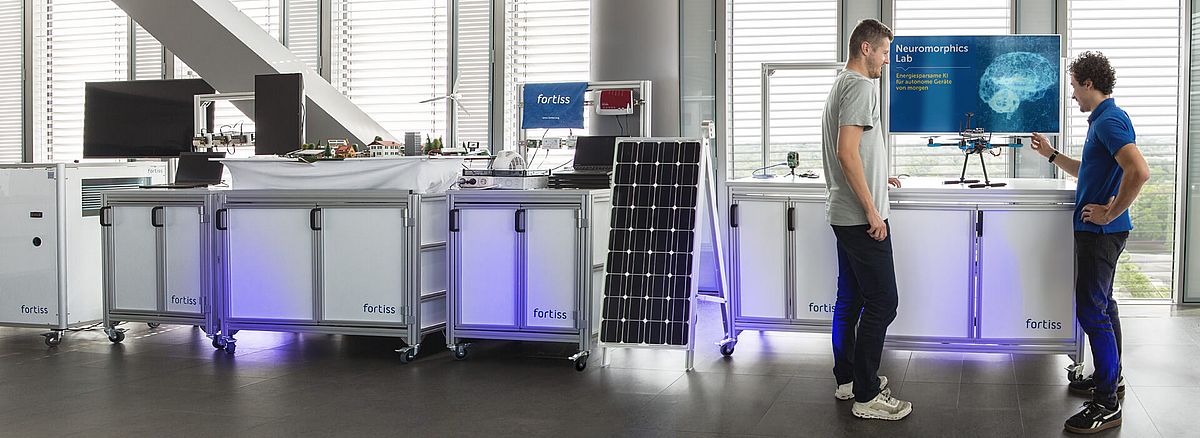
Energy-efficient AI for tomorrow’s autonomous devices

Space technology
With AI-powered, energy-efficient real-time technology, fortiss is advancing the space industry. Focus: limited resources, security, communication, and innovation through edge AI, neuromorphic systems, and autonomy.
Competencies
-
The trend in the space industry is to move more AI from the ground segment to the satellite. Neuromorphic and low-power AI accelerators make their way into in-orbit systems, as recent ESA projects prove. fortiss is a renowned expert in this domain.
-
Early fault detection, AI-based low-level telecom algorithms, mesh networking and inter satellite communications (ISL) can benefit from fortiss’ expertise in neuromorphic and machine learning.
-
Very fast-moving objects in space like debris are hard to track with conventional vision systems. That’s where event-based vision comes into play. With pixel latency down to the microsecond, the fastest objects can be tracked without blur or missing trajectory data.
-
Be it docking to a satellite, or manipulating debris with a robotic arm, control and perception need to be synchronized with highest accuracy. With event-based optical flow and spiking robot control, those operations can be achieved in much faster control loops.
-
Estimating self or third-party location, pose and speed is a challenge in space. Edge AI, combined with sparse event perception, enable for faster star trackers, satellite pose estimation and identification of objects in the vicinity, at a reduced power cost.
-
Landing speed estimation, perception and manipulators, rover autonomy, can be implemented with higher power efficiency and lower latency with fortiss edge AI technologies.
-
Integration of situational awareness, intervention and oversight in spatially intuitive interfaces, enabling efficient planning support (human-AI-collaboration) and cognitive control under uncertainty and delayed communication.
Reference projects
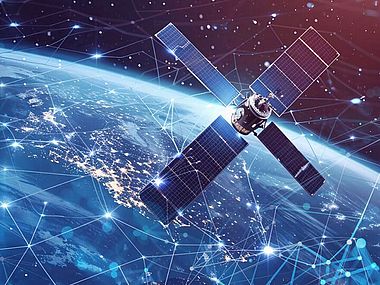
AI-based autonomous fault detection and resource management for satellite systems
Managing the complexity of cyber-physical systems through efficient, model-based development
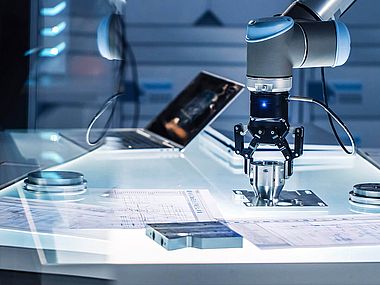
Industrial robots see with neuromorphic eyes
Insights

Integrated development environment for the aerospace industry

AI-based, autonomous on-board fault detection, isolation, recovery and resource optimisation in satellites
At a glance

Services for the defense and aerospace industries

Your innovation starts with fortiss

Energy-efficient AI for intelligent systems
Please contact us!
fortiss – Your innovation partner for the defense and aerospace industry
- Latest scientific findings: Access to current research results in software technology.
- Reliable engineering expertise: Expertise in the development of complex systems.
- Agile project methods: Flexible adaptation to market requirements and rapid project implementation.
- State-of-the-art research: Use of cutting-edge technologies for innovative developments.
- Specialized expertise: Implementation of industrial prototypes and tailor-made solutions for the specific requirements of the defense industry.
- Long-term partnerships: Development of sustainable solutions for a successful future.